
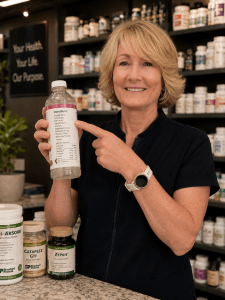
BEYOND THE DIAGNOSIS
HIDDEN TOXINS SERIES
What’s Really in Your Electrolyte Drink?
Manufactured Citric Acid, Aspergillus niger, and Why I Believe Consumers Should Understand What’s Behind the Label
By Dr. Laurie Dady, BS, MS, DC, FM
Have You Ever Wondered What’s Actually in Your Electrolyte Drink?
Walk into almost any grocery store, health-food store, gym, or vitamin shop today and you’ll find an entire section devoted to hydration.
Electrolyte powders. Hydration packets. Sports drinks. Flavored waters. Effervescent tablets.
They’re marketed as products that support hydration, exercise, recovery, and health.
But have you ever turned the package around and actually read the ingredient list?
I have—and there is one ingredient you’ll see again and again:
Citric acid.
Most people see those words and naturally think:
Lemons. Limes. Citrus fruit.
I certainly did.
But the citric acid naturally present in a lemon and the commercially manufactured citric acid commonly used by the food and beverage industry don’t necessarily come from the same source.
And that’s something I think consumers deserve to know.
Why This Became Personal for Me
I didn’t become interested in mold because it was a popular health topic.
I became interested in it because mold profoundly affected my own health.
My experience forced me to start looking at my environment differently.
I began looking more carefully at my food, water, supplements, indoor air, ingredients, and products I had previously used without a second thought.
It also changed how I looked at patients.
After more than 30 years in practice, one thing has become very clear to me:
Two people can encounter the same thing and respond very differently.
Why?
Our genetics aren’t identical.
Our immune systems aren’t identical.
Our gastrointestinal health isn’t identical.
Our nutritional status isn’t identical.
Our lifetime environmental exposures aren’t identical.
And our ability to process and eliminate compounds from the body isn’t necessarily identical either.
That’s why I’m so passionate about personalized healthcare.
It is also why an ingredient that may seem completely insignificant to one person can become something another person wants to investigate.
Natural Citric Acid and Manufactured Citric Acid Are Not the Same Story
Citric acid occurs naturally in foods.
Lemons and limes are obvious examples.
That isn’t what I’m concerned about in this article.
I’m talking about commercially manufactured citric acid.
Today, citric acid can be produced commercially through fermentation involving the fungus Aspergillus niger.
After fermentation, manufacturers separate and purify the citric acid before it becomes the ingredient used in food and beverages.
That’s an important distinction.
I’m not saying that a scoop of electrolyte powder contains living Aspergillus niger mold.
I’m saying something much simpler:
Consumers deserve to know how an ingredient is manufactured.
When someone reads “citric acid,” he or she may reasonably picture citrus fruit.
Commercial manufacturing can be very different from that picture.
Why Do Companies Use Manufactured Citric Acid?
There are legitimate functional reasons manufacturers use it.
Citric acid can:
- Provide the tart or sour flavor we associate with citrus.
- Adjust the acidity, or pH, of a product.
- Improve flavor.
- Help with product stability.
- Assist with preservation.
- Make salty mineral and electrolyte formulations more palatable.
That’s one reason you see it so frequently in flavored hydration products.
And electrolyte products are only the beginning.
Once you start reading labels, you may be surprised by how often citric acid appears.
It can be found in various:
- Flavored beverages
- Electrolyte powders
- Sports drinks
- Sparkling beverages
- Gummies
- Candies
- Sauces and dressings
- Packaged foods
- Supplements
- Personal-care and cosmetic products
That last category surprised me.
I’ve even found citric acid in products we aren’t eating, including certain skin and body products, where it may be used to adjust pH or as part of the formulation.
Again, my question isn’t:
“Is this ingredient bad for everyone?”
My question is:
“Do you know what you’re being exposed to?”
Why Would Someone With a History of Mold Illness Care?
This is where we need to be careful not to make every person’s health story the same.
Many people consume manufactured citric acid without noticing an obvious problem.
That needs to be said.
But some people dealing with significant environmental sensitivities or recovering from mold-related illness become extremely attentive to potential exposures.
I understand that because I’ve lived it.
My own experience changed how I approach my environment and what I put into my body.
It is also one reason I look at genetics and individual detoxification capacity in my patients rather than assuming that everyone processes environmental exposures identically.
DNA may influence susceptibility, but DNA isn’t destiny.
The environment matters.
Nutrition matters.
Gut health matters.
Liver and gallbladder function matter.
Sleep matters.
Stress matters.
Total exposure matters.
That’s why I don’t believe healthcare should simply ask:
“Is this ingredient considered safe?”
Sometimes another useful question is:
“Is this the best choice for this particular person, with this particular history?”
That’s personalized medicine.
Mold Exposure Isn’t Just One Thing
Another reason I want to begin the Hidden Toxins Series with this subject is that people often think about mold exposure too narrowly.
They picture a black patch growing on a bathroom wall.
Environmental exposure is certainly important. Mold spores can become airborne, and prolonged or significant indoor exposure can be particularly problematic for susceptible individuals.
But when I work with someone concerned about mold, I look at the whole picture.
Where are they living?
Where are they working?
Has there been water damage?
What is the humidity?
What’s happening with the HVAC system?
What are they eating?
What are they drinking?
What products are they using repeatedly?
My patient recovery materials emphasize addressing the environment, including moisture, HVAC filtration, HEPA filtration, leaks, and water-damaged spaces.
That’s because you can’t look at one exposure in isolation.
I think about the total burden.
Food Can Be Part of the Conversation Too
Food storage matters as well.
Agricultural products can be susceptible to fungal contamination under certain growing and storage conditions.
That’s one reason I’ve spent years teaching patients to pay attention to the quality and storage of foods such as grains, nuts, and coffee.
My mold diet materials have long discussed food-related fungal exposure and specifically address grains, nuts, seeds, and coffee as foods where sourcing and storage can matter.
This doesn’t mean everyone needs to become afraid of food.
Quite the opposite.
I want people to understand food better.
Fear doesn’t create health.
Education does.
This Is Why I Teach Patients to Read Labels
Reading labels isn’t about becoming obsessive.
It’s about becoming informed.
Turn the bottle around.
Look beyond the claims on the front.
“Natural.”
“Clean.”
“Healthy.”
“Hydrating.”
“Performance.”
Those are marketing words.
The ingredient list tells you what is actually in the product.
If you see citric acid, now you know something you may not have known before:
It may be commercially manufactured rather than derived directly from citrus fruit, and commercial production commonly uses fermentation involving Aspergillus niger.
Then you get to decide whether that matters to you.
That’s the point.
What I Tell My Patients
I don’t want my patients afraid of everything they eat, drink, breathe, or touch.
That isn’t health.
I want them educated enough to ask questions.
If you’re doing well, feeling healthy, and tolerating a product, that information is part of your individual picture.
If you’re struggling with unexplained symptoms or recovering from significant mold exposure and you notice that certain products don’t agree with you, pay attention to that too.
Look at the entire ingredient list.
Look at how often you’re consuming the product.
Consider your total environmental exposure.
And remember that something being appropriate for your friend, spouse, trainer, or neighbor doesn’t automatically mean it is appropriate for you.
Beyond the Diagnosis
This is exactly why I created the Hidden Toxins Series.
There are ingredients, environmental exposures, and everyday products surrounding us that most of us never stop to question.
I didn’t either—until my own health forced me to.
My goal isn’t to make you frightened of your environment.
My goal is to make you curious about it.
Ask what’s in your food.
Ask what’s in your water.
Ask what’s in the products you put on your body.
Turn packages around and read the labels.
And most importantly, learn to understand your own body.
Because good healthcare shouldn’t simply ask:
“What diagnosis do you have?”
We should also be asking:
“Why is your body responding this way—and what can we learn from it?”
That’s what it means to look Beyond the Diagnosis.
Dr. Laurie Dady, MS, DC, ND
Center for Health & Healing
About the Author
Dr. Laurie Dady, MS, DC, ND has spent more than 30 years helping patients look beyond symptoms to understand the underlying factors influencing their health.
Her approach combines natural medicine, nutrition, chiropractic care, personalized laboratory testing, environmental health education, and individualized lifestyle strategies.
Her interest in environmental illness is also personal. After experiencing significant health challenges associated with mold exposure herself, Dr. Dady developed an even deeper interest in helping patients understand how their environment, nutrition, genetics, and lifestyle can interact.
Through Beyond the Diagnosis, her goal is to help people ask better questions, understand their bodies, and become informed participants in their own healthcare.
Center for Health & Healing
DrDady.com
Next in the Hidden Toxins Series…
Hidden Mold in Coffee: Should You Be Concerned?
Coffee is part of the daily routine for millions of people. But coffee is an agricultural product, and how the beans are grown, harvested, dried, transported, and stored can matter.
In the next Hidden Toxins article, we’ll look at mold and mycotoxins in coffee, what consumers should understand, how quality and storage make a difference, and why some people may want to be more selective about what’s in their morning cup.